
6/5/2026
How Product Supply Helped Shape P&G’s Internship Program

From early manufacturing internships in the 1950s to a lasting approach to developing talent across P&G.
This post is part of a P&G Product Supply Brand Heritage blog series. Click the link below to read other stories in the series.
Did you know some of P&G’s earliest interns worked in Product Supply?
As early as the 1950s, Product Supply began employing interns across a variety of manufacturing roles. In the earliest days, Product Supply interns typically worked directly with individual teams on the manufacturing floor — learning by doing and contributing alongside the people around them. That hands‑on approach worked well, but it also revealed an opportunity to better connect teams and create a more consistent way to welcome and develop new talent across P&G.
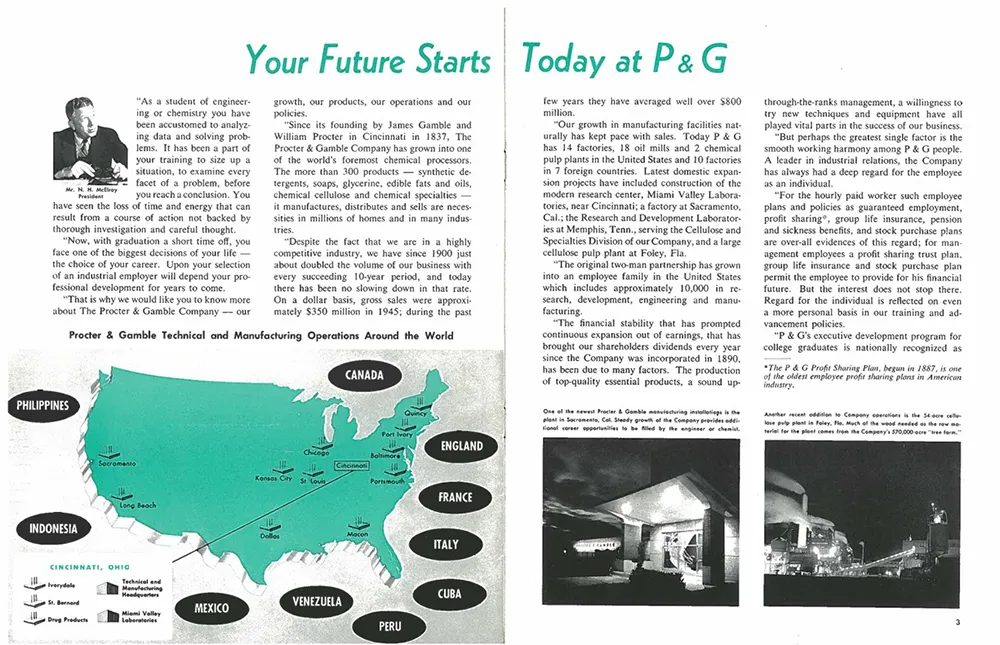
In 1954, then-CEO Neil McElroy authorized the development of a system which would enable the Company to work more effectively with colleges. This step created the foundation for what would become a thriving internship program — one designed to support the Company’s evolving business needs while preparing students for careers in engineering, chemistry, and manufacturing.
“As a student of engineering or chemistry you have been accustomed to analyzing data and solving problems. It has been a part of your training to size up a situation, to examine every facet of a problem, before you reach a conclusion.”
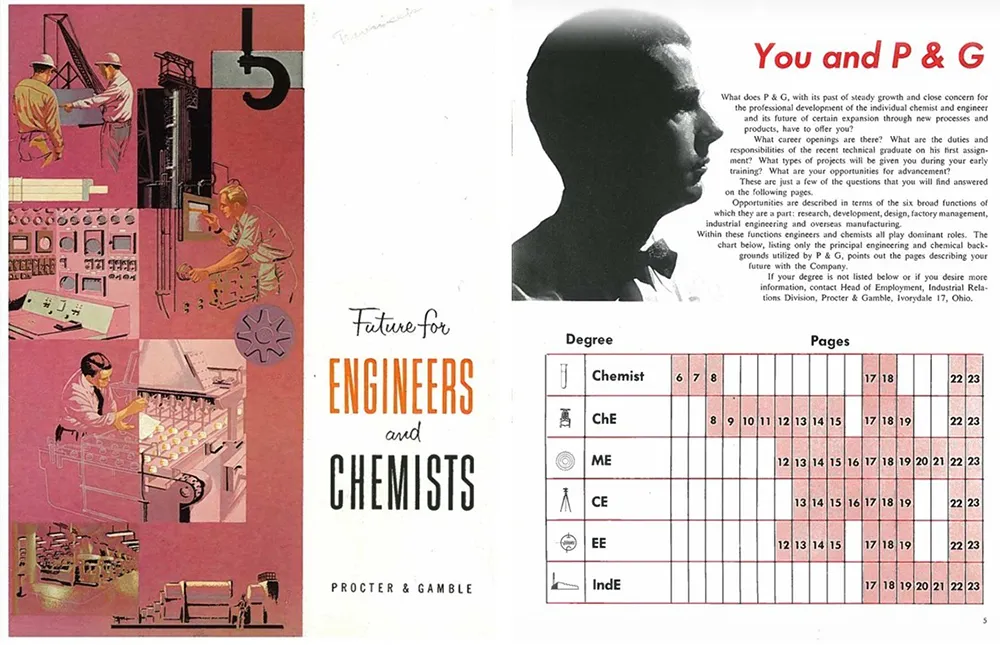
These early internships coincided with the expansion of roles in Industrial Engineering and Process Development during the 1950s. As highlighted in the 1955 Future for Engineers and Chemists pamphlet, P&G recognized the growing importance of combining technical expertise with real-world business application — an approach that Product Supply internships helped bring to life.
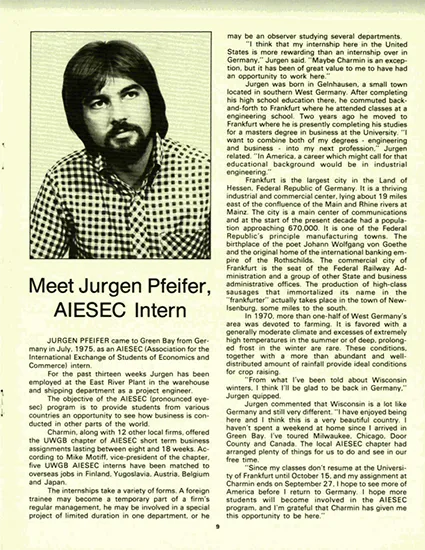
Over time, the internship program continued to evolve. By the 1970s, Product Supply internships were attracting participants from around the world. Individuals like Jurgen Pfeifer, who joined the program in 1975, gained early exposure to how engineering and business come together inside P&G — preparing them for long-term careers within the Company and beyond.
A 1990 Moonbeams article reflected on this growing legacy, noting that Product Supply had employed interns for decades across a wide range of manufacturing positions. What began as a practical staffing solution became a deliberate investment in future capability — one rooted in hands-on learning, technical rigor, and exposure to real manufacturing challenges.
“Our Company always has plans for the advancement of the business which are set to go — except for the necessary executive personnel to administer them. There is always room at the top of our organization for the right men, and Procter & Gamble will move ahead just as fast as we can find them.”
This history remains an important part of Product Supply’s identity — and a legacy of talent and innovation. For generations, internships have served as an entry point for students to experience P&G’s supply chain operations firsthand — and for the Company, a way to build the next generation of Product Supply talent.
4/27/2026
Crest’s Bright Breakthrough: How P&G Product Supply Managed a 100-Fold Demand Surge

A Legacy of Innovation and Agility—Delivering at Speed and Scale
In 1960, Crest entered a breakthrough period in innovation that step changed how consumers cared for and protected their smiles against decay — leading to quickly rising consumer demand. What followed was a rapid scale-up challenge in the supply chain.
“It was like flipping a switch — people were suddenly aware of Crest and its benefits, and they wanted it,” said Arnie Austin, a P&G Industrial Engineer at the time.

A Surge in Demand
As momentum built, demand for Crest rose sharply, leading to a remarkable jump in market share — from about 12% to nearly 20% within a few months. Letters and phone calls poured into P&G offices. Retailers who once ordered cases were now demanding truckloads as the product was flying off their shelves. Sales forecasts became obsolete as demand surged an estimated 100-fold.
The question wasn’t just how to capitalize on this historic breakthrough, but how to physically get the product into the hands of millions of Americans. And the answer came from the heart of P&G’s operational engine: its people and its agile, empowered supply network.

Navigating Production Challenges
From plant floors in Cincinnati and Iowa City to the corporate headquarters, teams mobilized with incredible speed. Manufacturing plants immediately shifted to 24/7 schedules. “It felt like a race against time,” Austin said. “It wasn’t just about making toothpaste; it was about fulfilling a promise to our consumers.”

Producing more paste wasn't the only bottleneck; the entire finishing process — filling, capping and packing tubes — had to be scaled at what was thought to be an extraordinary rate. The pace was intense, but the collaborative spirit was even greater, Austin said.

"It was a real challenge, but a great morale builder. We were doing things that had never been done before."
An Integrated Response
Looking back, P&G’s response was a strong example in cross-functional collaboration and successful execution of the integrated growth strategy and vectors of superiority.
- Engineering & Manufacturing: With manufacturing equipment being pushed to the limit, teams like Arnie’s worked tirelessly to examine every aspect of the production process to identify bottlenecks and streamline while ensuring superior quality products.
- Logistics & Sales: Planners rerouted trucks across the country, diverting shipments to areas where there was the greatest demand from shoppers. The sales force worked hand-in-hand with retailers to manage expectations and allocate stock fairly.
Within months, P&G’s supply chain not only met the initial surge but stabilized to consistently supply the new, elevated demand. P&G had turned a daunting task into a resounding success, cementing Crest as America's #1 toothpaste — a title it would hold for decades.
A Legacy of Agility
The lessons learned from that surge — the need for agility, cross-functional teamwork and an unwavering focus on the consumer — are the same principles that drive our modern Supply 3.0 strategy. Today, we leverage AI, advanced analytics and a synchronized network to respond to global events with the same dedication Arnie and his colleagues showed over 60 years ago.
The story of Crest is a powerful reminder that behind every P&G product is a supply chain built on a legacy of innovation and powered by people determined to deliver, no matter the challenge.

3/24/2026
How Did Tide Overcome Its Production Challenges to Set a New Industry Standard?

A Legacy in Constructive Disruption, Teamwork, and Tenacity
In the late 1940s, Procter & Gamble embarked on a transformative journey with the introduction of Tide, the world’s first heavy-duty detergent. While the product itself was an innovation, the story of how it was made is a powerful lesson in constructive disruption, teamwork, and tenacity.

1965 Tide Manufacturing
From the outset, the project faced considerable hurdles. However, leader Neil McElroy championed the initiative, asserting, “If we don't, someone else will.” His vision set the stage for a monumental effort.
As key team member Chuck Fullgraf shared, “We knew that to make Tide a reality, we had to innovate not just the product but also the process. It was a monumental task.”
The challenges were immediate. Existing equipment was insufficient, and the post-WWII era meant essential materials like stainless steel were scarce. As production ramped up, the team faced hurdles. “The granules were jamming the machines, and every stoppage meant wasted time and resources,” Fullgraf recalled.

1950’s Tide Manufacturing
Recognizing the urgency, the production team convened. Their goal was not just to fix the problem, but to “rethink the entire approach,” Fullgraf said.
They developed two key solutions. First, they reformulated the detergent to maintain superior performance and quality while improving flow. Second, they conducted rigorous time-motion studies, because, as Fullgraf noted, “every second counted.” This data-driven approach allowed them to pinpoint inefficiencies and systematically refine the production line.

Tide’s St. Bernard Plant Tower near Cincinnati, Ohio
While these process improvements were underway, P&G engineers persevered through material shortages to design and build entirely new machinery.
The massive St. Bernard Plant Tower came online in December 1946, followed by new towers in Dallas, Chicago, and Port Ivory. This expansion was critical to meeting demand.

Tide’s Chicago Manufacturing Plant
The results were staggering. Production skyrocketed from 275 million pounds in 1946 to over 1 billion pounds by 1950.
Fullgraf reflected on the achievement: “Tide didn't just change our product line; it set a new standard for the entire industry. It was a testament to what we could achieve when we faced challenges head-on.”

Tide Manufacturing line in 1953
That story serves as a powerful reminder that challenges are opportunities for innovation—a spirit that lives on in Product Supply at P&G today.
READ MORE STORIES ON OUR BLOG

2/20/2025
Supplying Your Favorite Products: From Production to Your Home
A sneak peek inside the journey your favorite products take to arrive at their destination.
Read more

6/12/2026
The Product Supply Perspective: Celebrating People, Excellence & Innovation
Meet the people behind P&G Product Supply — the global team driving the expertise and innovation behind the products consumers rely on every day.
Read more

6/1/2026
P&G Brands Top Circana’s 2025 New Product Pacesetters List
P&G continues to lead the way in innovation, demonstrating a deep understanding of consumer needs to deliver products that improve lives.
Read more